
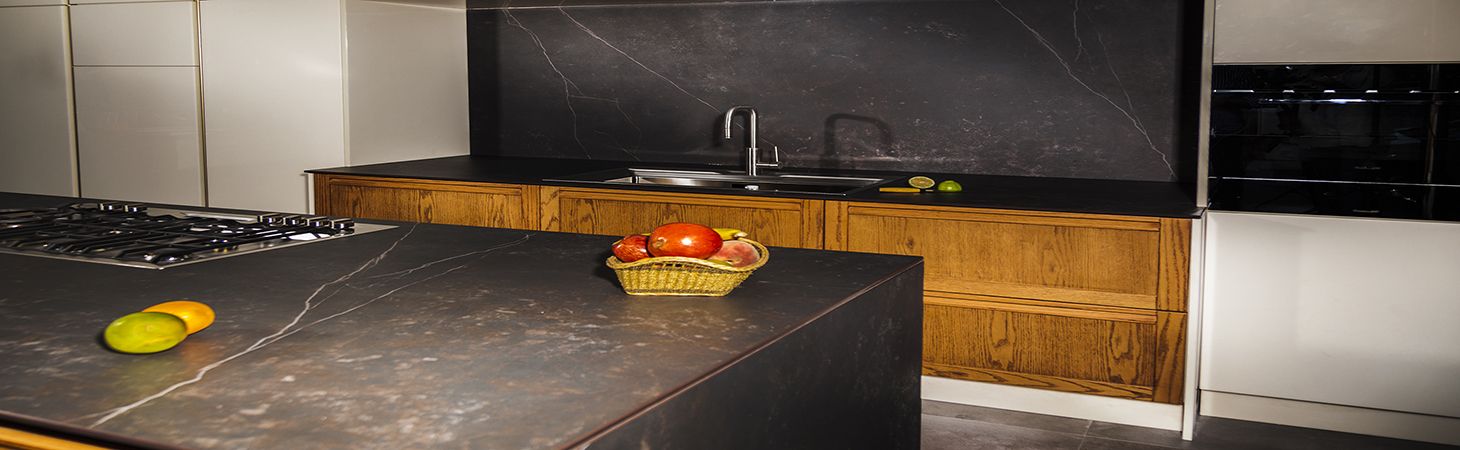
Dekton stone, composed of quartz crystal, porcelain and glass, is a Spanish product that has been welcomed by most people around the world. Dekton stone consists of compacted slabs created under a pressure of 2500 tons and a temperature of 1200 degrees Celsius.
Features of Dekton Stone
Because of its very high resistance to pressure, scratching and abrasion, Dekton is the most suitable option for use in high-traffic environments. The absorption property of Dekton stone is very low, and for this reason germs and bacteria cannot grow and multiply, and it is antibacterial.
- Variety and stability of designs and colors
- Antibacterial and hygienic
- Insulation against heat and cold
- Resistant to heat and fire (Dekton has a very low expansion coefficient. This feature gives this product high resistance to heat and cold. Therefore, using Dekton for building applications in very hot and cold regions is the most suitable choice. In addition to its beautiful and stunning appearance, Dekton also has other very important advantages. This product is noncombustible, and because of its high fire resistance, no burn marks, blackening or cracks appear on it.)
- Resistant to scratches and abrasion (Dekton has unparalleled resistance to scratches and scraping caused by sharp objects being dragged across it.)
- Resistant to acids and other environmental pollutants
Applications of Dekton Stone
Dekton stone is used in kitchens, bathrooms, floors, walls, fireplaces and restrooms.
- Because they are scratch-resistant, artificial Dekton stones are the most suitable choice for kitchen counter surfaces. This is because the counter is, in fact, the kitchen table.
- Because they are antibacterial and hygienic, Dekton stones are the best option for restaurants, hotels and hospitals.
- Today, Dekton stone is used more often around the world to build fireplaces, because it shows high resistance to heat and fire.
- Artificial Dekton stone is used in the exterior facade design of large, modern buildings. This is because this product has special advantages such as resistance to acids, environmental pollutants and stains, a lack of tendency toward chemical reactions, a wide variety of designs and colors, and resistance to heat and cold.